Or: How I Learned To Stop Worrying And Love Brain Dumps
Last spring I worked through The Artist’s Way, the self-help book written by screenwriter Julia Cameron. Over the course of 12 weeks, the book dives into a lot of the reasons that artists (especially the ones who have to juggle their creativity with the responsibilities of a day job) let their talents wither, and suggested some creative exercises to help work through the mental blocks.
If I’m perfectly honest, I’ve forgotten most it.
While a lot of what Cameron writes about in the book resonated very deeply with me, other portions — particularly the stuff where she writes about creativity as an outlet for spirituality — never rang true. I could never suspend my disbelief enough to let the Great Creator flow through me. This is not ideal for someone who’s currently writing a novel, but I digress.
However, there is one exercise in the book that has stuck with me. In fact, I think it’s fair to say that it’s changed my life.
The most important exercise in The Artist’s Way, at least in my opinion, is the morning pages. The aim of the exercise is simple: get up in the morning, as early as you can, and write three pages of longhand stream-of-consciousness. That’s it. No deadlines. No themes. Just you, a pen, and a page. The idea, as Cameron describes it, is to empty the brain of any lingering worries or doubts, thereby making it easier to focus on whatever creative project you actually want to be devoting your brain cells to.
I’ll be the first to admit that as a writer, I’ve never been particularly disciplined. So when I first read the pages, I thought that I’d keep it up for the dozen weeks I took to work through the book before abandoning the exercise pretty quickly.
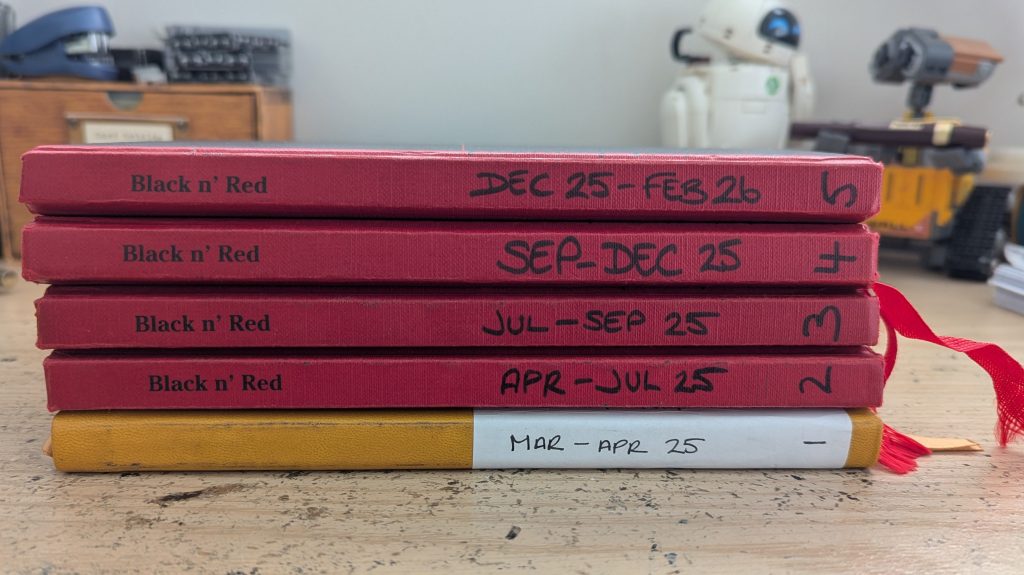
As of this morning, I’ve been writing pages for a whole year.
Cameron actively discourages looking back through your pages after finishing them. After all, the whole point is to remove thoughts from your brain. Besides, reading back over my own non-fiction writing still gives me ‘the ick’, as the kids would say: if you’ve ever cringed your way through a recording of your own voice, you’ll know exactly what I’m talking about. But I was curious to see how my approach to morning pages has changed over the last twelve months, so this week I blew the dust off some of my old notebooks and had a flick through them. I was shocked to discover that I barely recognise the writer I was when I started.
My earliest entries — the ones I wrote when I was working through The Artist’s Way — feel a lot more like exercises (almost as if I was working through some kind of self-help programme!). One week’s task was to come up with a series of affirmations to repeat to myself, so I decided to end all of that week’s entries by writing them out over and over again. I probably thought I was being so clever by using up more of my pages that way. There’s also an undeniable reservation in what I’m writing; like I’m holding back in places, maybe out of fear that some third party would come across the notebook one day and some terrible secret would be shared.
So what changed, between then and now? In a word: therapy. I started seeing my (brilliant) therapist in late 2024, just a couple of months before I bought my copy of The Artist’s Way. After a few sessions of braindumping face-to-face with a random stranger, the idea of being honest in a notebook only I would read started to feel like child’s play by comparison. By the end of the course, I no longer had to strain to fill three A5 pages. Instead, the words poured out of me. Eventually I even felt confident enough to reduce the frequency of my therapy sessions, because the act of writing pages gave me the same sense of relief that talking to my therapist does. It hasn’t replaced her entirely — to be honest, I think I’ll probably be in some form of therapy for the rest of my life — but it works as a kind of valve that keeps the pressure in my brain from building too quickly. It’s a bit like trepanning with a fountain pen.
It’s not just about emptying my head, though. The more I think about it, the more I believe that morning pages have just helped me to become a better writer. I find myself reaching for words and grasping them much more easily than I used to. Sometimes the pages are a good place to brainstorm whatever idea’s been worming its way into my brain on a given day. And that’s without mentioning the fact writing three pages longhand every day made me realise that I just really enjoy writing things longhand. I’ve become the kind of person who has not just a fountain pen but a collection of fountain pens. Hell, writing these morning pages every day was partly what inspired me to try writing the rest of my first novel longhand as well: a decision that paid off handsomely.
Back at the start of the year I talked about trying make 2026 all about PERSISTENCE, and I can’t think of a better example of that in action than the morning pages. It’s amazing how quickly its’s become a habitual part of my day, and if I find myself missing a morning (either due to illness or work or just really wanting a lie-in), I can just shake it off and start again tomorrow.
Morning pages have truly changed my life, and I’d recommend it to anyone. You’d be surprised at what comes tumbling out of your head once you give it a really good shake over a blank page.
Thanks so much for reading! If you enjoyed these musings, please consider subscribing so you don’t miss my next post!

 Phil W. Bayles
Leave a comment