Or: How I Learned The Value of Friction
There’s this meme I’ve been thinking about for a little while now.
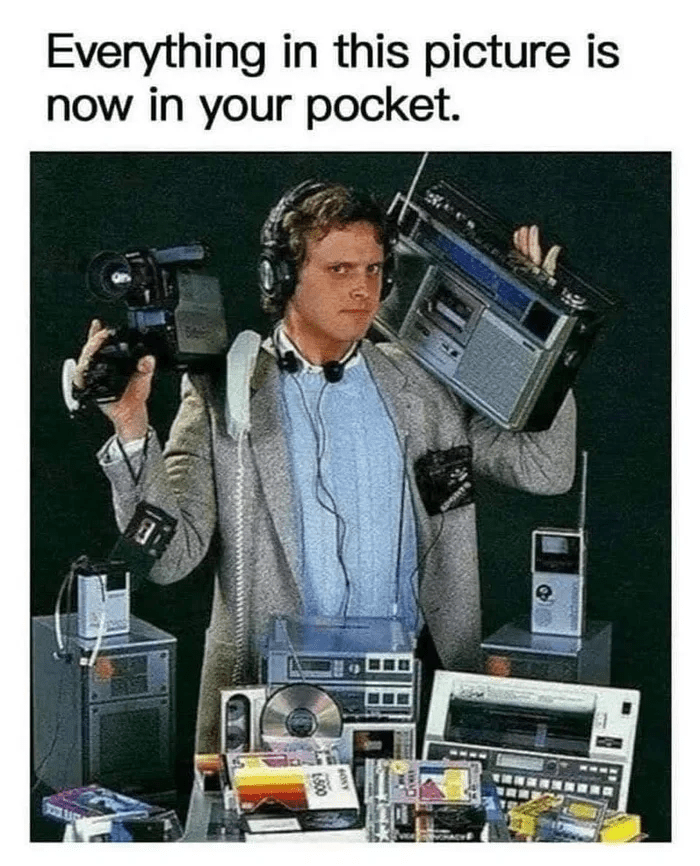
It’s a picture of the most 80s-looking man in history — come to think of it, he actually resembles Michael J Fox — surrounded by 80s-looking technology. He’s got a boombox on one shoulder, a giant camcorder on the other, and in front of him are all sorts of gadgets in all their boxy, beige plasticky glory. The caption simply reads: “Everything in this picture is now in your pocket.”
I’ve always loved a shiny new toy, and I’ll admit that I’ve been happy to lap up the supposed benefits of the technological innovations of the last decade same as anyone else. But somewhere along the way, the convenience of having everything in your pocket has turned into a crutch. A lot of digital ink has been spilled over the last few years about “enshittification” — the term coined by Cory Doctorow to describe the way that much of the internet has pivoted away from providing help to users in favour of providing value to shareholders. All of which goes a very long way to explaining why so much of the internet absolutely sucks right now. If it’s not social networks drowning our attention spans in 30-second vertical videos, it’s Google poisoning its own well with stupid AI summaries that are full of inaccurate (and sometimes dangerous) information.
The problem, in a nutshell, is friction; or rather, the lack of it. Once I get the little dopamine hit that comes from a notification on my phone, it’s far too easy to check my emails, or bounce over to social media, and find that I’ve suddenly wasted an hour. And it’s not just on my phone, either: I’ve lost count of the number of times that I’ve fallen down a YouTube rabbit hole when I’ve been at my desk at work, or trying to get some writing done on my home PC. Which brings me back to that old advert I mentioned at the start. Recently, I found myself looking at those two pictures and thinking: “Maybe the before picture wasn’t so bad.”
So this year I’ve begun the process of taking my life out of my pocket.
Looking back, I realise I actually started this journey a long time ago; about two and a half years ago, in fact, when I bought my trusty leather notebook. I used to have a real issue with consistently using notebooks, but this one comes with me whenever I leave the house. Forgetting it feels as discombobulating as if I’d forgotten my watch, or my trousers.
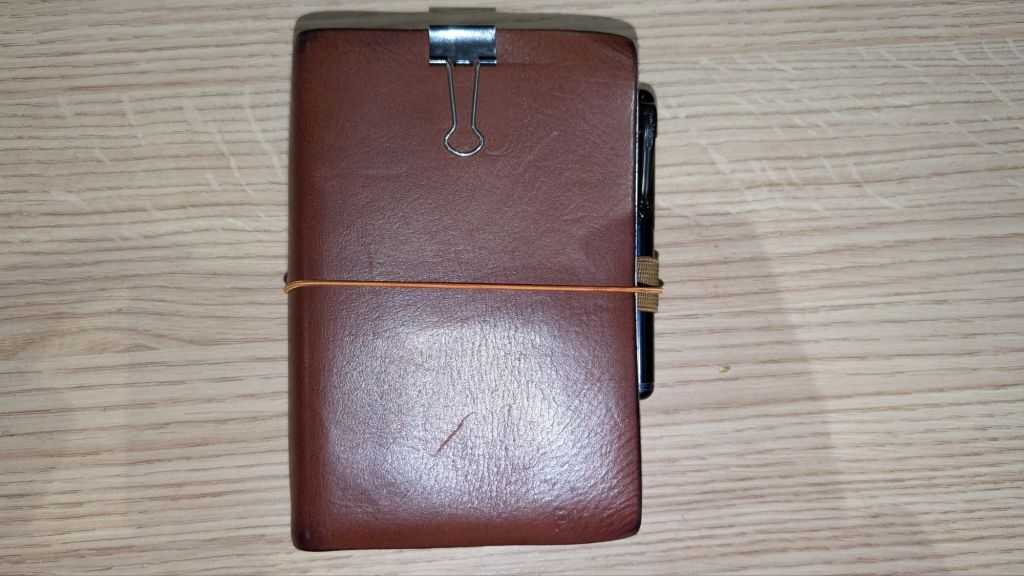
And though it’s sometimes fiddly as hell to whip it out, open it up and scribble out a reminder or a thought to myself, I do find that I hold on to the information I’m writing out much more easily. Hell, writing by hand was the only way that I got the full first draft of my novel finished! Since then, most of the stories that I’ve penned have started out with a handwritten draft, and I think the work is much better as a result.
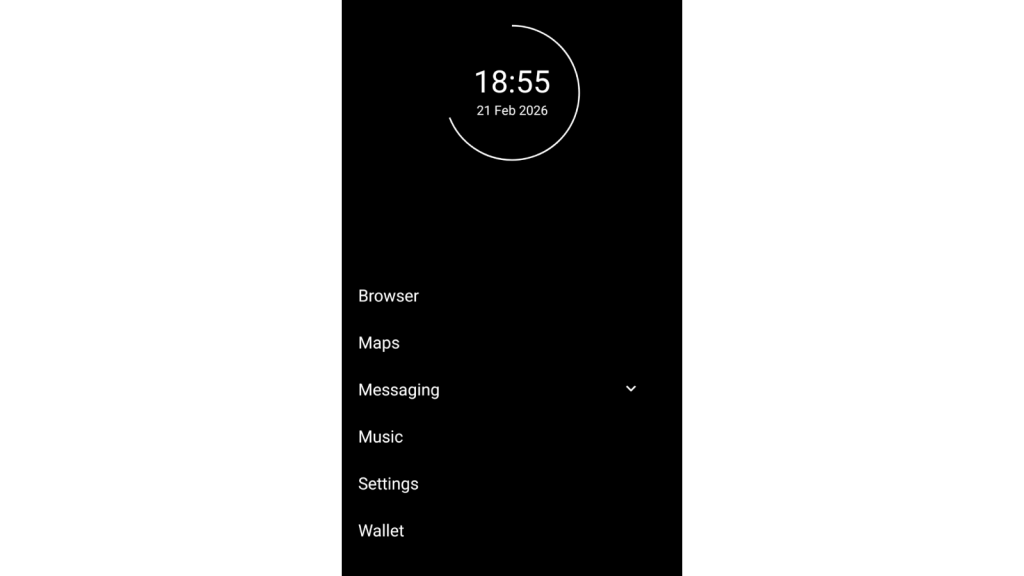
Over the last few months, I’ve decided to kick things up a notch. I’ve deleted a ton of apps off my phone, including social media, so now if I want to view Bluesky or Instagram or Reddit or Facebook I need to access them on my phone’s browser. I’ve also put very strict timers on for each of those websites: 15 minutes a day on each, and that’s yer lot. I’ve installed a minimalist launcher to replace all the exciting icons with a boring list of apps, and I’ve even put a greyscale filter on the screen to make my feeds as uninteresting as possible (that last one also has the fun unintended consequence of making my Instagram feed look all arty and French, which is fun).
But by far the biggest change so far is the tools I’m using to write. I’m deep in the process of revising the novel, and writing new scenes in Scrivener is proving strangely difficult. It’s that lack of friction again: it’s far too easy to get stuck mid-sentence, reflexively hit Alt+Tab and find myself mindlessly surfing the web. Given that most agents and publishers would probably not appreciate me sending them all handwritten manuscripts, typing is probably still the best way to go. What I needed, I realised, was a dedicated writing machine.
Finding the right thing took a bit of trial and error. After spending a lot of time on eBay looking at typewriters, I realised that it was probably, if anything, less practical as a solution than handwriting. I doubt my wife would appreciate the sounds of me hammering away at the keys late at night, and I’d probably get some funny looks if I took one on the train with me.
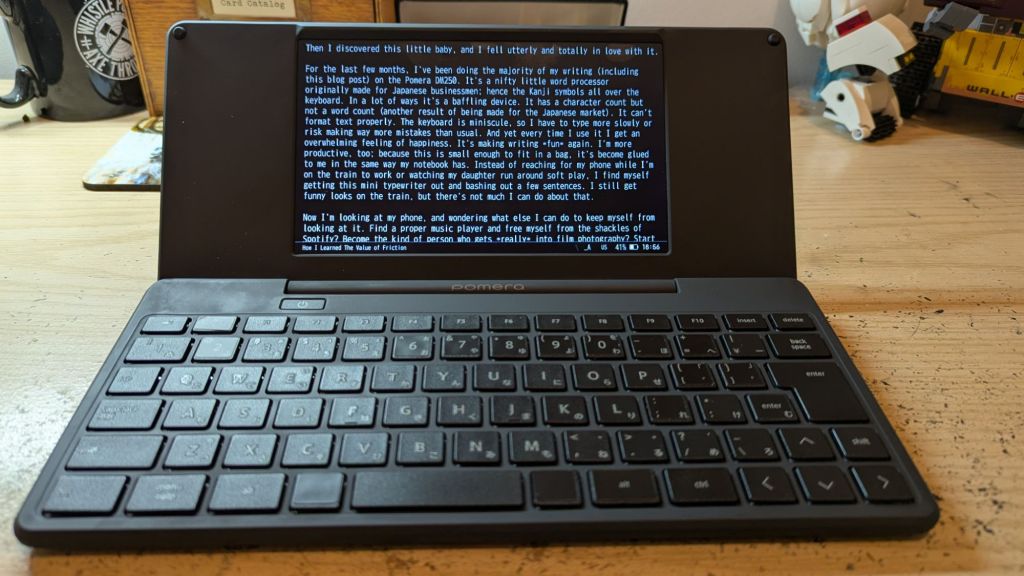
Then I discovered this little baby, and I fell utterly and totally in love with it.
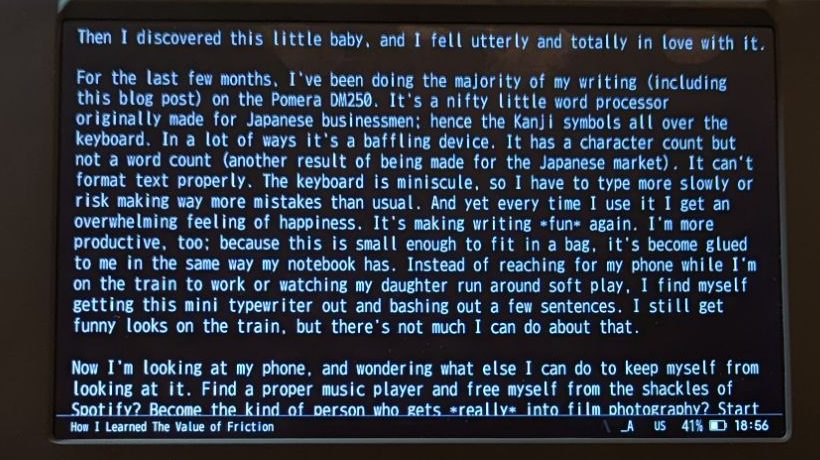
For the last few months, I’ve been doing the majority of my writing (including this blog post) on the Pomera DM250. It’s a nifty little word processor originally made for Japanese businessmen; hence the Kanji symbols all over the keyboard. In a lot of ways it’s a baffling device. It has a character count but not a word count (another result of being made for the Japanese market). It can’t format text properly. The keyboard is miniscule, so I have to type more slowly or risk making way more mistakes than usual.
And yet every time I use it I get an overwhelming feeling of happiness. It’s making writing fun again. I’m more productive, too; because this is small enough to fit in a bag, it’s become glued to me in the same way my notebook has. Instead of reaching for my phone while I’m on the train to work or watching my daughter run around soft play, I find myself getting this mini typewriter out and bashing out a few sentences.
(I still get funny looks on the train, but there’s not much I can do about that.)
Now I’m looking at my phone, and wondering what else I can do to keep myself from looking at it. Find a proper music player and free myself from the shackles of Spotify? Become the kind of person who gets really into film photography? Start carrying around an A-Z of Sheffield in order to make Google Maps obsolete?
There are limits to how far I’m going to take this experiment in single-use devices. I don’t see myself replacing my smartphone with a Nokia 3310 any time soon. There are some ways that smartphones are generally great, and I don’t want to just throw the virtual babies out with the digital bathwater: going paperless where I can is always good, like with train tickets for my work commute, and Google Maps remains objectively the best way to get directions to somewhere. It’s about making sure that I’m always using the right tool for a job, instead of trying to cram as many jobs as possible into a single tool.
Turns out, once you add a little bit of friction into your life, things start going a lot more smoothly.
My wonderful friend Joe Pearson, who also happens to be one of my favourite writers, has a brand spanking new website! If you like the idea of stories that “smell like bonfire smoke on a distant planet”, then check it out and subscribe to his newsletter (after you’ve subscribed to mine, of course!).

 Phil W. Bayles
Leave a comment