Or: How I Learned That I Would Happily Live in Omelas
I suspect I’m going to be thinking about the ending of Clair Obscur: Expedition 33 for a very long time.
It is one of the most extraordinary video games I have ever played: a staggering feat of artistry and storytelling, made all the more impressive by the fact that it’s the debut game from a studio consisting of about thirty-odd people. There are so many things I want to talk about. There’s the epic score, equal parts haunting and beautiful; the way it completely revolutionises turn-based combat by taking old ideas and synthesising them into something new; the fact that it is excessively, almost violently French (this is a game where all the characters can be dressed up in berets and stripy tops, which you earn as a reward for beating up mimes).
But the thing that’s stuck most in my head in the last couple of days is the ending. In its final moments, Clair Obscur does something that very few video games have ever done: it made me feel like a complete and utter bastard.
MASSIVE spoilers beyond this point. Don’t say I didn’t warn you.
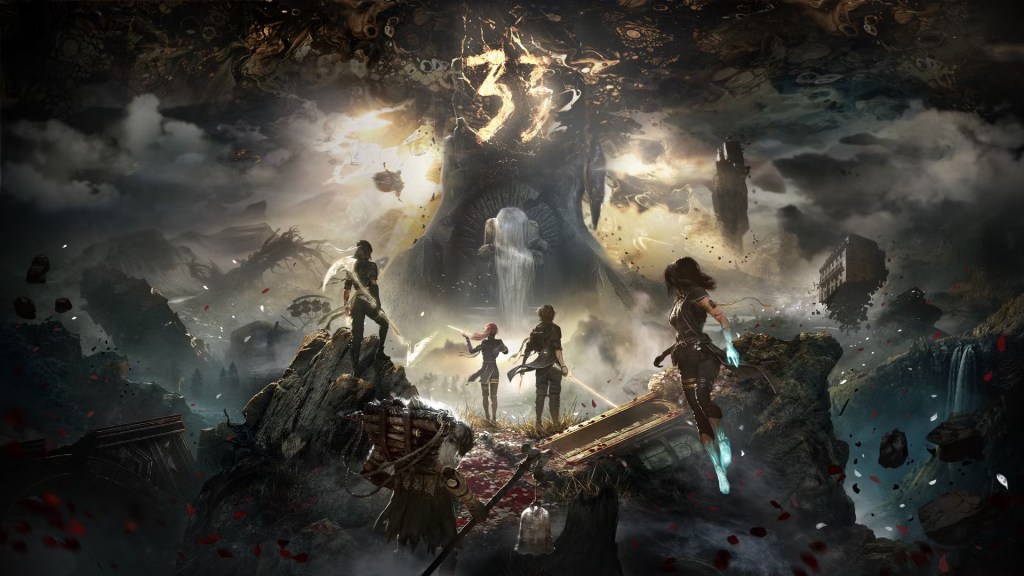
But first, some context. Clair Obscur takes place in the world of Lumière: a distorted and surreal version of Paris which lives in the shadow of an enormous monolith, and the godlike Paintress who sits at its base. Once a year, she rises to paint a new number on the monolith — and everyone of that age vanishes into dust. She started at 100. She’s down to 33.
Our heroes are members of Expedition 33, a group of ragtag volunteers who set out for the dangerous Continent across the sea in order to kill the Paintress and stop her fatal countdown forever. They know that not all of them will survive, but most only have a year left to live. What do they have to lose?
Quite a lot, it turns out.
While the world of the Continent is beautiful, the journey is almost unrelenting in its bleakness. The Expedition’s beach landing is a massacre on par with Saving Private Ryan; all but four of the Expeditioners are dead in minutes. Gustave — the charming, affable everyman who’s been positioned as the Expedition’s leader — is cruelly slain a few short hours later by Renoir, the game’s antagonist. That’s the end of Act I.
But the Expedition has a motto: “When one falls, we continue.” When one falls; not if. So they continue. With the help of a mysterious stranger named Verso they brave the monsters on the Continent; they reach the peak of the monolith; they defeat the Paintress and return home as heroes.
Then the game reveals its cruellest twist of all, as the entire remaining population of Lumière is wiped out in one fell swoop. The Paintress’ annual countdown wasn’t bringing about the apocalypse; it was slowing it down.
The Continent, Lumière, and all its inhabitants are the creation of Verso Dessendre: a young man with the magical ability to paint life into canvas, who was tragically killed in a fire. The Paintress is Verso’s mother Aline, who in her grief elected to remain in the Canvas with the last portion of her dead son’s soul. She even created a copy of her son: the Verso who joined the Expedition on their mission. Renoir, Verso’s father, was determined to destroy the Canvas and everything in it in order to bring his wife back to reality so she could grieve properly. And Maelle — Gustave’s 16-year-old ward who joined him on the Expedition — is actually Verso’s sister Alicia, another young Paintress, reborn without any of her previous memories after she entered the Canvas.
After a final confrontation with Renoir, Alicia/Maelle convinces her father to spare the Canvas, but Verso is determined to see it destroyed. The two siblings find the last piece of the real Verso’s soul: the ghost of a young boy, forced to paint forever. They come to blows, and the player is forced to make a choice: side with Verso, or Maelle? Destroy the Canvas, or spare it? Whichever character the player sides with, the other one must die.
For me, there was only one choice. In the real world, Alicia was a living ghost; left scarred and mute by the fire that killed her brother, abandoned by her parents and her older sister. In the Canvas, as Maelle, she had a life and a voice. Then there’s the other characters: the Expeditioners who I’d come to know and love over the many hours I played the game. And the other residents of Lumière: hundreds of real, living people with families and memories and souls. To erase the Canvas would be to commit genocide. So I killed Verso in order to save it.
As the epilogue started, the world seemed to have righted itself. Maelle had brought back everyone in Lumière — including Gustave! — and the city is bright and happy again. But then I saw Verso, resurrected once more, and remembered his chilling final line: “I don’t want this life.” I remembered the ghostly little boy, who nodded silently when Verso asked him if he wanted to stop painting. And in an absolutely chilling final shot, we see Maelle’s face slowly being corrupted, just like her mother’s before her.

One of my favourite short stories ever is The Ones Who Walk Away From Omelas by Ursula K. LeGuin. Thematically, it is identical to Clair Obscur, though at roughly 2,800 words it’s a fraction of the length. In the story, the city of Omelas is a utopia: a place where everybody is happy and nobody lacks for anything. But that happiness is built on terrible foundation that every citizen is eventually made aware of. Deep in the bowels of the city, locked in a tiny windowless room, is a small child: cold, naked and starving. If anyone were to remove the child from that room, or clothe it, or even give it a kind word, then “all the prosperity and beauty and delight of Omelas would wither and be destroyed.” Some citizens, as the title of the story implies, leave the city, unable to have that kind of suffering on their conscience. The majority decide they can bear it.
I had always believed that, if I lived in Omelas, I would be one of the ones who walked away. The idea of letting a child suffer, even if it meant sustaining a perfect world, would have been unthinkable. But when I was given that very choice — shown a child who would continue to suffer forever to prop up the world — I didn’t hesitate for a second to prolong his torment. I was utterly convinced that I was doing the right thing. And if I had to do it over again, I’m not sure I would do it any differently.
I’m certain there are people who will be steadfast in their belief that destroying the Canvas was the only right choice: that by keeping it alive, Maelle is denying herself the chance to properly mourn Verso’s death and move on. But there really isn’t a right decision here: just a group of flawed people, broken by grief, trying to do whatever they think will make them feel even a little better.
Roger Ebert once said that a great movie is a machine that generates empathy. I think the same is even more true of a great video game, because of their inherent interactivity. And it’s that willingness to empathise — and an unwillingness to go for the easy answers — that makes Clair Obscur: Expedition 33 one of the most fascinating games I have ever played. I may have walked away from Lumière for now, but I don’t think I’ll ever forget it.
If you also enjoy The Ones Who Walk Away From Omelas, I’d highly recommend this short story by Isabel Kim that acts as a kind of companion piece to it.

 Phil W. Bayles
Leave a comment