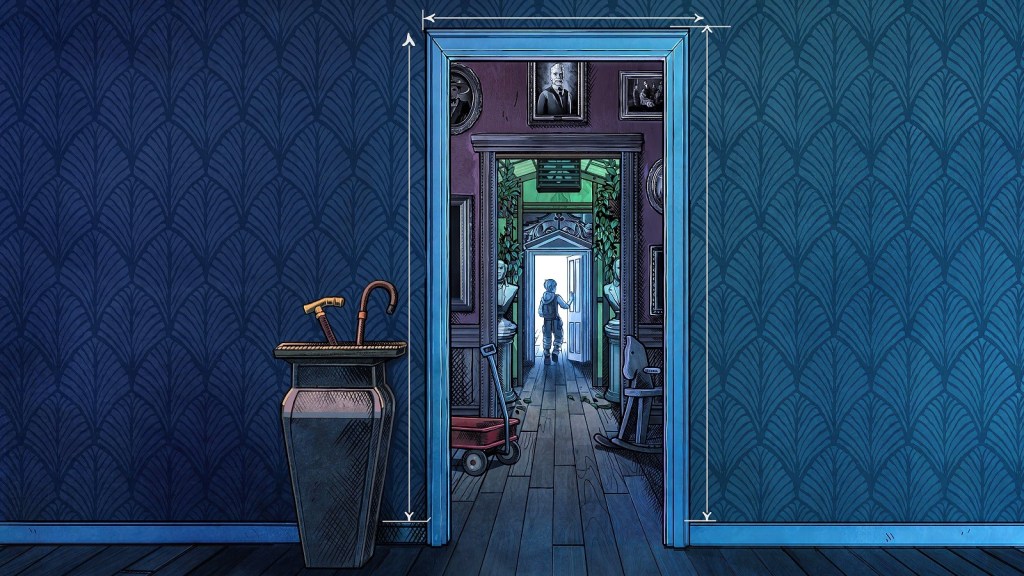
Or: How I Learned I Might Be A Masochist
Have you ever had a conversation that makes you feel stupid, but in a good way?
The kind of conversation where someone who’s extremely knowledgeable very gently blows your mind without ever once being condescending? You’re trying desperately to keep up, and slightly worried that your every contribution makes you sound like a troglodyte, but it’s just so thrilling to be in the presence of someone so clever?
God, I live for those kinds of conversations.
Anyway, the reason I bring this up is because I’ve recently been playing a video game called Blue Prince, which somehow gives me that same exhilarating feeling despite me being the only person in the room.
Developed over eight years by solo developer Tonda Ros, Blue Prince is about a young boy named Simon who inherits a mansion from his eccentric old uncle. There are, however, two provisos. The first is that, in order to keep the house, he has to find Room 46… in a house that only has 45 rooms. This is made exponentially more complicated by the second proviso: the house is always changing. Every time Simon comes to a locked door he has to choose which room will appear on the other side of it. At the end of each in-game day, the house resets.
I knew that Blue Prince was going to be my kind of game when an early tutorial suggested that I might want to grab some paper and a pen and start taking actual, physical notes to help me remember things. So, like a sedentary Indiana Jones, I whipped out my trusty notebook and got scribbling.
Here’s just a sample of the nonsense that I wrote down (spoilers for anyone who might play the game, obviously):
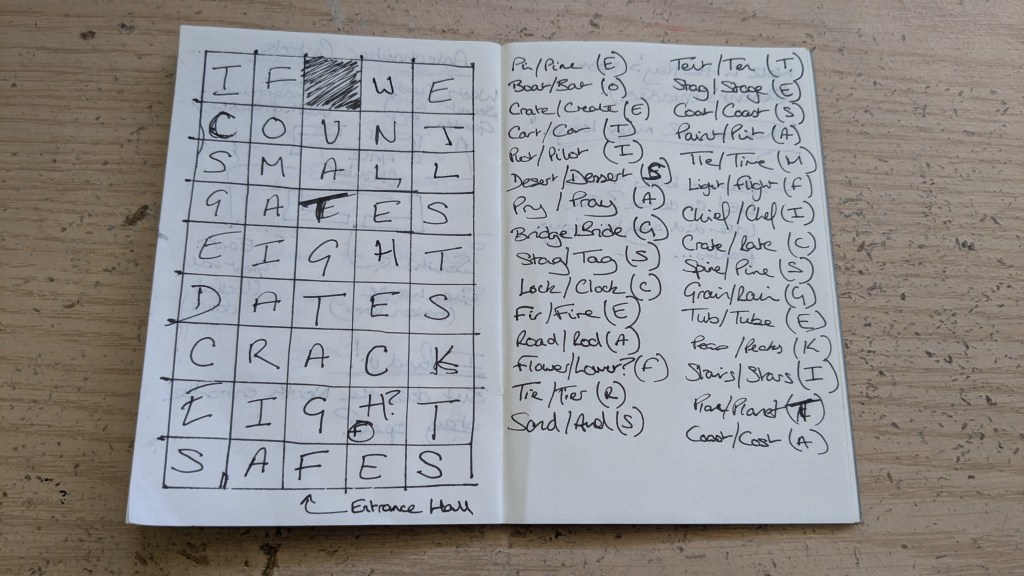
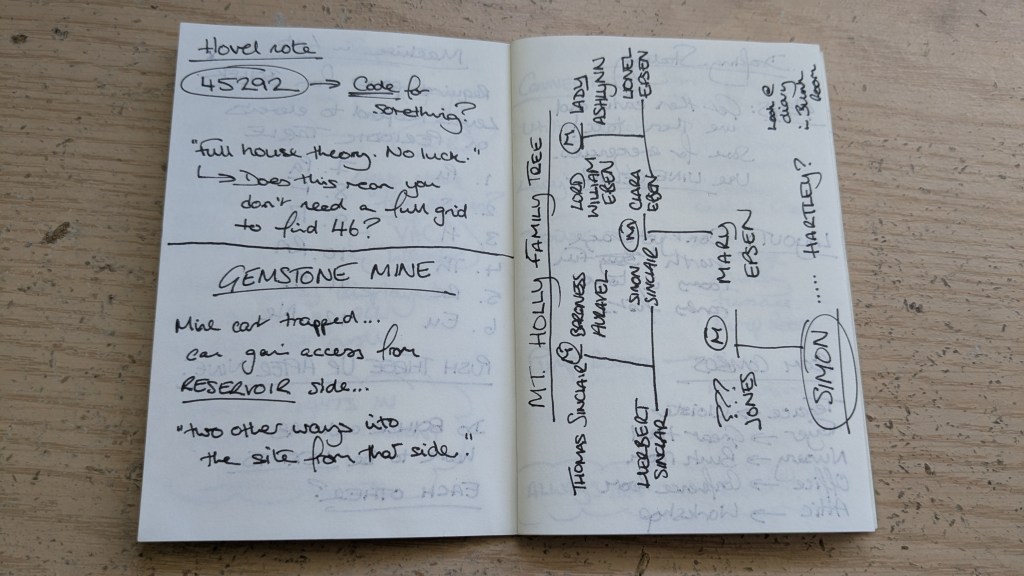
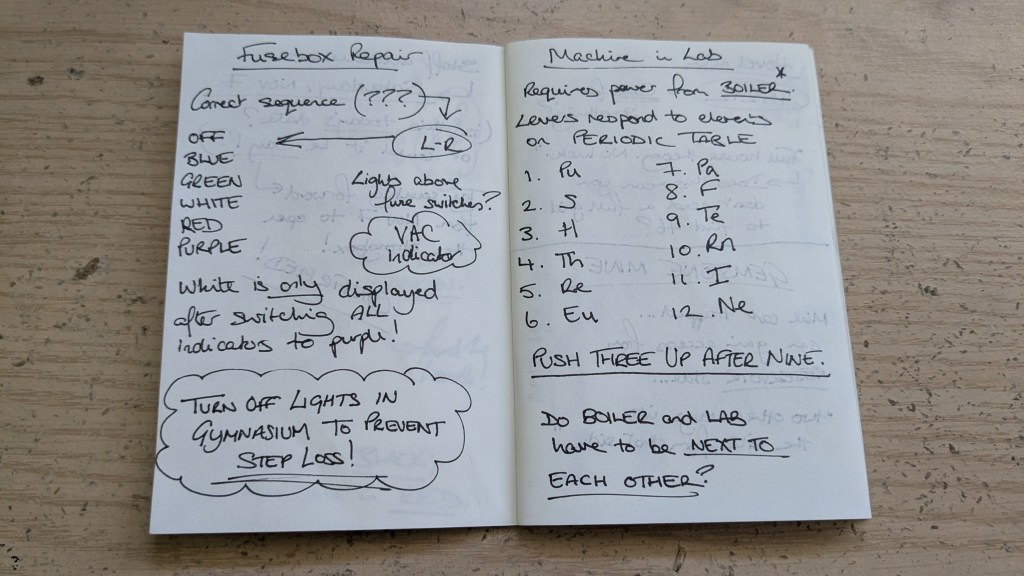
What I adore about Blue Prince is that the puzzles are pitched absolutely perfectly. There’s none of the obtuse nonsense that plagued adventure games of the 1990s, where you had to find some cat hair to make a false moustache so you could pretend to be a man who doesn’t even have a moustache in his passport photo. The clues to solving each puzzle are available right from the start; you just might not have the proper context to understand them yet. And once you do put the pieces together, you’ll wonder how you could have missed something so simple in the first place.
It’s also a masterclass in one of my favourite forms of fiction: environmental storytelling, the narrative that gets revealed through minor background details. Even now that I’ve made my way to Room 46, the mansion is still full of secrets that I’m only just discovering; it turns out that this seemingly simple puzzle was also hiding a political intrigue and a moving family drama as well, and I can’t wait to see what other narratives will start to unravel as I pull on the remaining loose threads.
What makes Blue Prince most exciting to me, though, is the fact that it’s just the latest in a long line of games in what is fast becoming my new favourite genre. The unfortunate name they’ve been saddled with is metroidbrania, but I prefer to call them detective games. Most video games, when you boil them all the way down, are about finding increasingly elaborate keys to fit inside increasingly intricate locks. Sometimes, the lock in question is a wave of enemies and the key is a gun. But in detective games, the keys are all based on knowledge. If you don’t know how to solve a puzzle, it’s because you haven’t yet tuned into the game’s way of thinking.
In other words, it makes you feel dumb. But in a good way.
Detective games aren’t a new phenomenon — by some counts, the genre’s over a decade old by now — but they’re only getting more popular. More than that, though, I think they might just be the future of the medium. The games industry is in a weird place right now; developers and journalists alike are being stripped of their careers in droves as a cadre of greedy, myopic executives decide to chase new fads in the name of infinite growth. But games like Fez, or Outer Wilds, or Return of the Obra Dinn, or Blue Prince, prove that there’s another way. These are all games made by incredibly tiny teams (or in some cases, a single person) that prove you don’t need cutting-edge technology to make an enduring classic. All you need is a brain, and the faith that your audience has brains as well.
Now, if you’ll excuse me, I’m off to play some more Blue Prince. I’m this close to figuring out what the chess pieces are for…

 Phil W. Bayles
Leave a comment