Or: How I Learned Every Game Needs A Musical Level
This is a first for me.
I’ve made plenty of lists sharing all my favourite movies in a given year, but I’ve never done a list of my favourite video games. Which is odd, given that I play a lot of them.
But 2023 felt like a particularly noteworthy year for the medium, for better and for worse. Corporate greed led to unprecedented numbers of game developers — more than 6,000 — being laid off this year. The Israel-Hamas War has led many to ask whether key industry figures have a duty to speak about current events. The rise of generative AI has left many artists and developers fearing for the future of their jobs.
Yet despite all that uncertainty, the year also saw the release of an embarrassment of gaming riches: titles that pushed new ground and took bold leaps forward. And since I want to keep things optimistic, I wanted to share five of my favourites.
5. Humanity
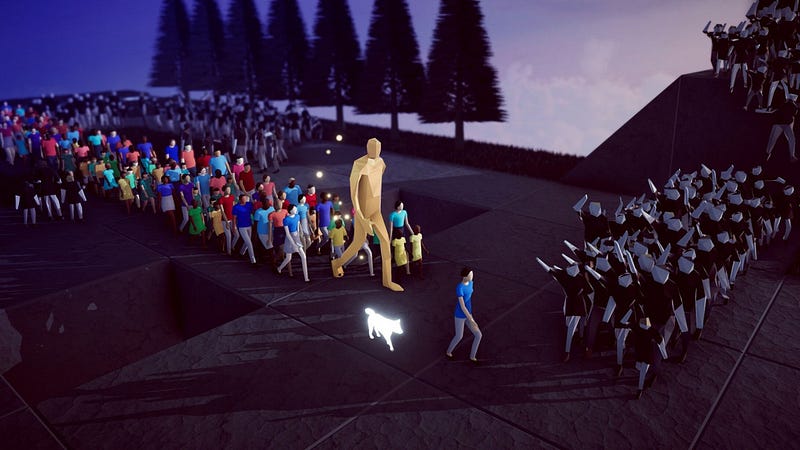
Humanity begins with an ethereally glowing Shiba Inu remarking: “I awoke one morning to find I was a dog.” Things only get weirder from there.
The actual gameplay is, at least at first, remarkably simple. Playing as the ghostly pooch, your task is to guide a crowd of faceless humans through a surreal, minimalist dreamscape while lo-fi music pumps in the background. It’s a spiritual successor to games like Lemmings — the difference being that thanks to the power of modern consoles, Humanity can render crowds of thousands of little figures at once instead of just dozens: great rivers of people that hypnotically twist and undulate as you lead them into the light.
If that’s all there had been to Humanity, it would have been enough. The puzzles were well-calibrated to be challenging without ever being frustrating, and the oddness that permeated the whole thing never stopped being charming.
But then an odd thing started to happen: Humanity got profound. It started asking genuinely poignant questions about its namesake — our fondness for conflict, our desire for order and stability, our seeming inability to make rational decisions on our own. It was cynical at times, to be sure, but by the end, it was also hopeful.
Not bad for a game where the main character can only communicate by barking.
4. Final Fantasy XVI
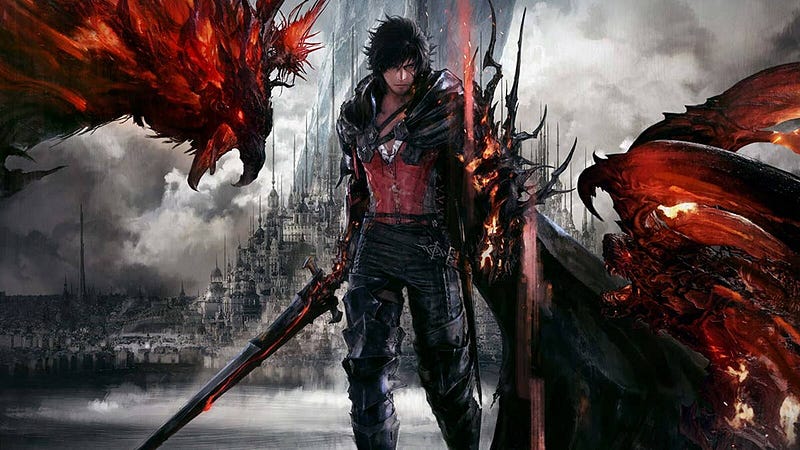
Before Final Fantasy XVI came out this year, the last game in the series I’d actually played to the end was Final Fantasy X, released way back in 2001. It’s curious that FFXVI was the game that brought me back to the series because, in the run-up to its release, so much of the conversation was about how unlike a Final Fantasy game it supposedly was.
Thankfully, the faithful need not have worried. Yes, the series’ traditional turn-based combat was dumped in favour of hack-and-slash gameplay more reminiscent of Devil May Cry. And yes, the story was (heavily) inspired by Game of Thrones, full of blood and sex and people saying “fuck”. But this was unmistakably a Final Fantasy game, and not just because there were Moogles and Chocobos and a bloke called Cid (this time brilliantly voiced by the inimitable Ralph Ineson).
FFXVI understands that Final Fantasy games at their best are both unashamedly silly and painfully earnest. Strip away all the gubbins about giant monsters and mountain-sized magical crystals, and you’re left with a heartfelt story about a group of people who love each other deeply and desperately want to make the world a better place.
3. Sea of Stars
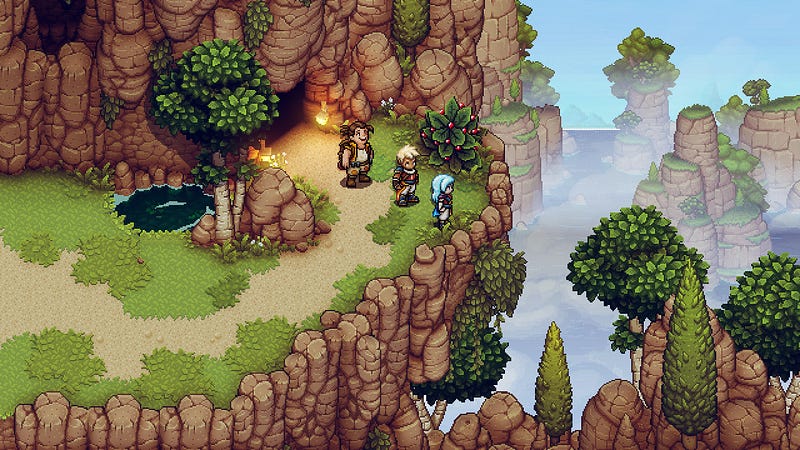
I knew nothing about Sea of Stars before its release, but as a PS Plus subscriber, I was able to download it for free on the day it was released. I’m so glad I did because I can’t remember the last time a game took me by surprise the way this one did.
It has a stunning pixellated art style, with dozens of unique areas bursting with visual creativity. The story is simple but captivating, compelling characters (none more so than Garl the Warrior Cook, who might be my favourite game character of the year). And the gameplay loop of exploration and turn-based combat is practically perfect: rather than piling on unnecessary features like some RPGs, it gives the player a small set of mechanics and lets them experiment until they master them.
I have never played Chrono Trigger, or any of the games from the Super Nintendo era that Sea of Stars is reportedly inspired by. While that might mean I don’t get the full experience of playing it, it also means I’m not blinded by the nostalgia they might evoke in people who have.
Sea of Stars is just a damn great game in its own right.
2. Baldur’s Gate 3
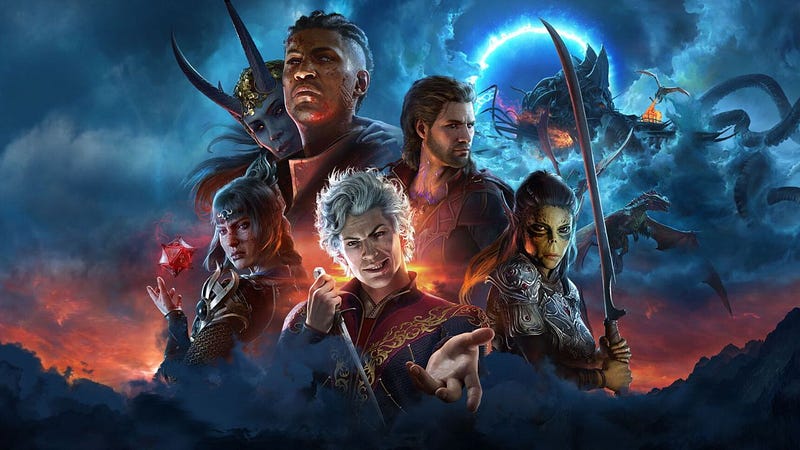
I spent more time playing Baldur’s Gate 3 than any other game in 2023, and I know that I’ve barely scratched the surface of it.
For more than 120 hours, I explored the world of Faerûn as Digby, a violin-playing Dwarf bard with a ginger beard and a magical prosthetic eyeball (which has a pretty funny story behind it), getting into all kinds of adventures. Some of them would determine the fate of the world itself; others were just about trying to help one person in need.
What they all had in common was that they were my stories — they were guided by my choices, and at every turn the game made it very clear that things could have gone very differently had I made a different choice. Even without that tantalising possibility, I would gladly play for another 120 hours just to spend more time with some of the most well-realised characters I have ever seen in a game.
Baldur’s Gate 3 is the epitome of designer Frank Lantz’s famous declaration that games are “operas made out of bridges.” Its existence feels like nothing short of a miracle, and its influence on the entire medium will be felt for many years to come.
1. Alan Wake II
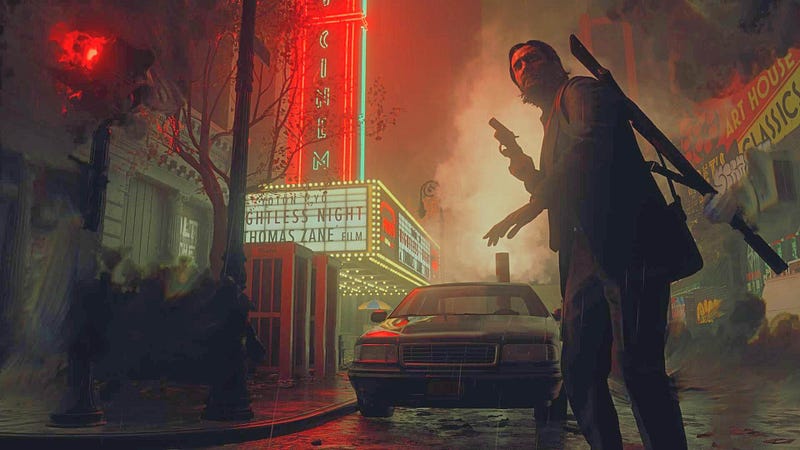
Alan Wake II is, undoubtedly, the best game I’ve played all year. It’s also one of the weirdest games I have ever played, and I mean it as a very sincere compliment.
Big-budget, AAA titles like this aren’t normally allowed to be weird. They can’t afford to be; any quirks need to be sanded down for the sake of appealing to as wide an audience as possible. They certainly can’t stop the action to make the audience watch a Finnish art film for 15 minutes. Or turn one level into an extended heavy metal musical number for no reason.
Alan Wake II does both of those things, and so much more besides.
While its developer, Remedy Entertainment, has been experimenting with form and narrative in its games for years, Alan Wake II sees them confidently pushing the limits of the medium further than ever before. But that weirdness isn’t just for its own sake. It’s all in service of a brilliant piece of metafiction about creativity: about the sacrifices we make to bring something into the world, the bits of ourselves we leave in our creations, and the ways they can take on a life of their own, beyond our control.
It took 13 years for Remedy to release Alan Wake II, and it was worth every minute of the wait. I can’t wait to see what Sam Lake and co. do next.

 Phil W. Bayles
Leave a comment