Or: How I Learned To Stop Worrying and Love Subtitles.
We’re all looking for ways to escape this little ongoing apocalypse of ours (well, those of us in countries that haven’t got their act together yet – New Zealand, you just keep doing what you’re doing). Recently I’ve been doing that by immersing myself in a different apocalypse: the irradiated world of the Metro games, based on the book series of the same name by Dmitry Glukhovsky.
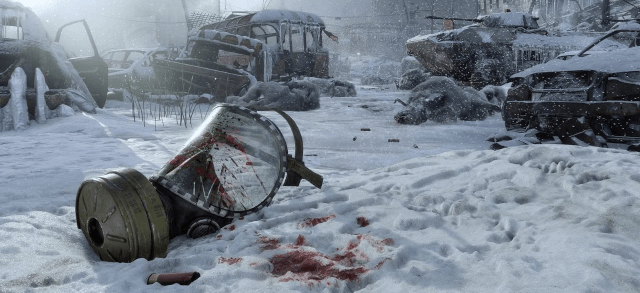
I’m a sucker for speculative fiction, and the premise of the Metro games is a doozy. In their world, a nuclear war in the year 2013 has devastated the Earth. The only survivors were the people who happened to be in the Moscow metro system at the time of the blast (in fact, many of the city’s metro stations were actually designed to function as fallout shelters). 20 years later, the Metro stations have evolved into miniature nation states, with wars and alliances being played out in the tunnels.
It’s a fantastic setting, and the game’s developers do a wonderful job of immersing the player in it completely. The protagonist, Artyom, never speaks, but the game never leaves his perspective, and there are thousands of little systems that you have to keep track of. When venturing out to the surface, you need to constantly replace the filters on your gasmask to survive the radioactive streets. You need keep your weapons clean so they don’t jam as you try to ward off a mutant bear. Ammunition is scarce, and it’s also used as currency – meaning every time you pull the trigger, you’re literally blowing your savings.
I’ve played the Metro games many times before, so all of this felt pleasingly familiar to me as I fired them up last month. It was like coming home to a childhood bedroom – albeit one covered in radioactive waste and mutant bears. But this time I played the game with Russian audio, and it felt entirely different. Somehow it felt more real.
Videogames have transported me to the furthest reaches of the universe, the four corners of the globe and the bottom of the ocean. Sooner or later, though, I’m always reminded that I’m sitting on a sofa in my pants. And in Metro, that tends to happen whenever the characters open their mouths.
The people Artyom meets on his journey are wonderfully three-dimensional characters with rich backstories and personal motivations, but they’re all voiced by American and British actors doing accents that are as strong as vodka and thick as borscht. It’s hard to listen to their tales of woe while I’m trying so hard not to giggle.
With that one tweak in the audio settings, everything changes. I no longer feel like I’m playing someone wandering through post-apocalyptic Russia. I feel like I am walking through post-apocalyptic Russia. I feel like I belong in this world, even though I don’t speak a word of the language. It’s a beautiful language to listen to, though, which makes all some of the (admittedly overlong) soliloquies easier to listen to. The only thing that doesn’t make sense is why Artyom never speaks. At least before I could pretend he was being polite because he doesn’t speak English; now he just seems like an arsehole.
In the ‘dubs vs subs’ argument, I’ve always been firmly on the side of subtitles, at least when it comes to films. There’s a surreal disconnect that comes from hearing English dialogue slapped over the mouth of someone who clearly isn’t speaking English. And yet I’ve never felt the same way about games before – maybe because they’re an inherently interactive medium, so the disconnect never feels quite as pronounced.
Now that I’ve finished Metro, though, my mind is racing with new possibilities. How different will it feel to play as a samurai in Ghost of Tsushima when everyone is speaking in Japanese? Since I speak fluent French, maybe I should return to Assassin’s Creed and its take on Paris during the French Revolution?
When South Korean director Bong Joon-Ho won Best Picture last year for his brilliant film Parasite, he had a piece of advice for the English speakers watching in the audience: “Once you overcome the one-inch-tall
barrier of subtitles, you’ll be introduced to so many amazing films.” Maybe I should try and do the same thing with the games I play in the future.
It shouldn’t be too hard to overcome that one-inch tall barrier in video games. After all, most of them have a jump button.

 Phil W. Bayles
Leave a comment