Or: How I Learned A Picture Really Is Worth A Thousand Words.
Anyone who knows me will tell you that I have a soft spot for animation.
I got the bitten by the bug early; in fact, the very first film I ever saw in a cinema was A Bug’s Life (I got the ticket off the back of a Happy Meal box), and after that I was hooked. I devoured Disney classics over and over until I could sing the songs off by heart. I laughed along at all the double entendres on Animaniacs, even though I wouldn’t understand most of them for another 20 years.
But what sticks out most in my mind are the moments of quiet; when animators eschew words entirely. To me, there’s no finer piece of comedy than seeing Gromit laying down a model train track in The Wrong Trousers. The ‘Married Life’ sequence of Up never fails to make me cry, and the first 40 wordless minutes of WALL-E remain the greatest thing that Pixar has ever produced. Those are the moments when animation becomes truly transcendent.
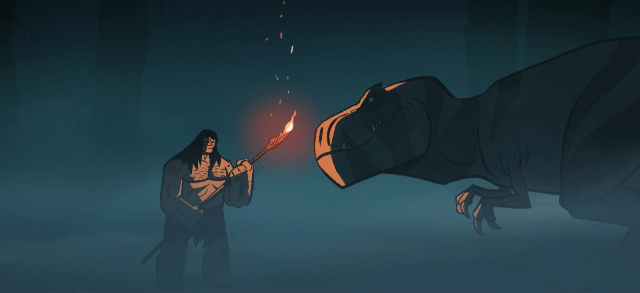
This last week I got hooked on Genndy Tartakovsky’s Primal; a limited series that stretches the idea of animation without dialogue to breaking point. There are 10 episodes, each about 20 minutes long, and there’s not a single word to be heard. It feels wrong to call this television, or even art. It feels like a force of nature – a cave painting on a stone wall, brought to life by flickering flames and a little bit of magic.
The plot is so simple that it’s barely a premise: it’s about a caveman named Spear and a dinosaur named Fang, who band together to survive in a prehistoric world where everything is trying to kill them. And I do mean everything – this is a land that’s filled with violence, from gigantic monsters to extreme weather. Even the two protagonists struggle to co-exist; we’re constantly reminded that like Richard Parker, the tiger in Life of Pi, Fang is a wild animal that could turn on her human friend at any moment.
Yet that violence sits right alongside some moments of real pathos and catharsis. Spear and Fang are brought together in the first episode by unbelievable tragedy, and it haunts them for the rest of their adventures. The third episode starts on a scene of harsh cruelty and ends with a surprising note of compassion. There are even some moments of physical comedy, from impeccably-timed sideways glances to full-on slapstick.
It’s also unbelievably gorgeous to look at. The world of Primal is vibrant and lush, almost painterly, but the characters who live there are drawn with sharp, savage lines. Taken individually, almost every frame could could be the cover of a pulp novel or a death metal album. In motion, they’re a tale full of sound and fury that actually signifies a hell of a lot.
I understand that this might not sound like the most uplifting show. I don’t blame anyone for wanting to retreat into more comforting fare – hell, I’m now rewatching The West Wing for the billionth time. But there’s also something oddly hopeful about Primal. It finds beauty and humanity in an unforgiving landscape, and present us with two beings who understand that the only way to survive it is together. All without saying a single word.
You know how some books use a little row of asterisks to break up two different scenes? This week I learned that it’s called a ‘dinkus’. And now that fact is stuck in your head too. Come on, it’s not like you were going to use those brain cells for anything important.
I recently found this keyboard that’s designed to feel like an old-fashioned typewriter, and I’ve fallen a little bit in love. I’m not saying you have to get me a Christmas present this year, but if you were thinking about it…

 Phil W. Bayles
Leave a comment