Or: How I Learned To Enjoy Writing Haikus
Doing nothing is very rarely an option in a video game.
As an interactive medium, they’re almost constantly pushing you to do something; fight the next battle, find the next treasure, finish the next objective. Stand still for too long in a Sonic The Hedgehog game and the little blue critter starts tapping his foot impatiently, staring out from the screen as if to say “What’s the hold up?”
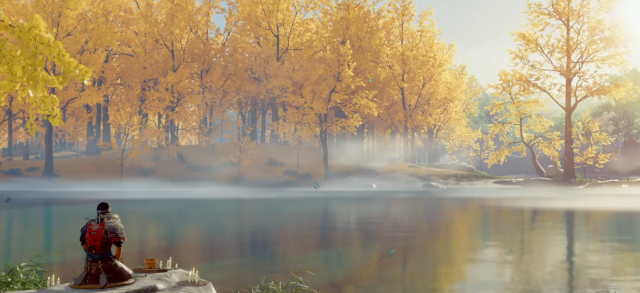
So it was surprising whenever Ghost of Tsushima invited me to lower myself into a hot spring and simply spend a moment thinking about my favourite food, or sit in front of a gorgeous sunlit vista and compose a haiku. I can’t remember the last time a game encouraged me to take a load off.
That’s not to say that Ghost of Tsushima doesn’t have moments of intense action, or a story you’re encouraged to finish. It’s an epic tale about the Mongol invasion of the Japanese island of Tsushima in 1274, but it’s also a story that’s full of internal conflict. The protagonist, Jin Sakai, is a samurai bound by a strict code of ethics struggling to defeat an enemy that refuses to fight honourably. Over the course of the story he turns from a noble warrior to something like a wild west outlaw, unafraid to do terrible things to protect his homeland and its people. But that struggle took up only a fraction of the hours and hours I spent playing the game.
As I wandered around the bamboo forests and mountain trails of Tsushima, the game constantly threw breadcrumbs my way. I crossed paths with birds and foxes, who enticed me to follow them with the promise of treasure. Plumes of smoke on the horizon drew me to towns and temples. Even the elements pushed me forward; you’re guided through the world not by a line on a map or an arrow pointing to your next objective, but gusts of wind that blow towards your destination.
And what did I find when I got there? Often, it was nothing.
The foxes led me to shrines, where I was prompted to take a moment to pray to the gods. The birds led me to the aforementioned hot springs and haiku spots, where there was nothing to do but sit with Jin’s thoughts. The island was littered with temples that were tucked away on remote hillsides. Each one was at the top of a treacherous climb, and the reward for getting up there was… nothing.
OK, that’s not entirely true – the hot springs would give my character more health, while visiting the hilltop temples granted me charms to improve my abilities. But those felt secondary to the reward of a stunning view, and a moment of calm.
I’ve always played a lot of video games, but since lockdown I’ve gravitated towards titles that made me feel like I was taking charge, imposing my will on the universe in some small way. I spent hours in the world of The Witcher 3, roaming between medieval towns and slaying monsters for money. I played The Last of Us Part II, and went on a deeply personal mission of vengeance through post-apocalyptic Seattle. Both games were fulfilling, in their own ways, but they both left me exhausted.
Ghost of Tsushima has reminded me of the value of stopping to feel the breeze in my hair and smell the flowers – even if they are digital.

 Phil W. Bayles
Leave a comment